
The Loopholes That Built New York
`New York City has a lot of rules about buildings.
There are rules about how tall a building can be, how much of a lot it can cover, how far it has to be from the street, how much sunlight has to reach the sidewalk, and how much space has to be left between one building and another. These rules are a huge part of why New York looks the way it does. The shape of the city's skyline isn't random. It was designed, at least in part, by the zoning code.
But here's something strange: if you actually start reading those rules, you'll notice that a lot of buildings in New York seem to break them. There are buildings that are much taller than the rules appear to allow. Buildings that take up more space than they should. Buildings that seem to have somehow squeezed extra floors into places where extra floors aren't supposed to fit.
How are they getting away with it? It's not like someone secretly built a 60-story skyscraper overnight and hoped nobody would notice. You can't exactly sneak a building past the New York City government. Someone would've noticed.
New York's zoning code is incredibly complicated, and over the years the city has created all sorts of ways for developers to build more than they otherwise could. Sometimes these arrangements are practical. Sometimes they're the result of decades of changes to the zoning code. And sometimes they produce something that sounds completely made up. Welcome, friends, to the wonderful world of New York zoning loopholes. No, don’t go away, I promise this is interesting.
Imagine you own a small building on a lot where zoning rules would allow you to build ten stories, but you've only built five. You have five stories' worth of development potential that you're not using. In certain parts of New York, you may be able to sell those unused development rights to a neighboring property. Your neighbor can then use them to build a larger building than they otherwise would have been allowed to build. In most places, if you own a piece of land, you probably think of your property as the dirt, the building sitting on it, and whatever happens inside that building (I’m aware that I’m explaining pollination to a bee right now, but stay with me). But in the city, you also own something more ethereal: the air above. Air rights have been a hot topic in New York City for the better part of a century now, and people seem to realize how absurd of a concept it actually is.
In the late 1980s, developer G. Ware Travelstead wanted to build a gigantic new skyscraper at 383 Madison Avenue, but there was a problem: the site didn't have enough zoning capacity to build the tower he wanted. The solution was to buy 800,000 square feet of unused air from Grand Central Terminal. There was just one little zoning problem: Grand Central and 383 Madison weren't adjacent, across the street, or even kitty-corner (catty-corner? Which one do you use?). The two lots were separated by several blocks of Midtown. Normally, that meant the air rights couldn't be transferred. Penn Central, the company that owned Grand Central at the time (I know it’s confusing) liked the idea, though, and with Travelstead, came up with a bizarre argument: they claimed the two properties were connected underground. Penn Central owned the railroad tracks and subterranean property running between them, so, in their interpretation, there was a continuous chain of ownership, even though there wasn't one above street level.
The city was not buying it. Officials pointed out that accepting the argument could mean Grand Central's air rights could effectively be transferred anywhere along Penn Central's underground railroad network (first Madison Ave, next Montreal!). The dispute went to court, the city ultimately won, and the proposed tower was shelved. But the fight had a strange consequence: New York changed its zoning rules so that Grand Central's air rights could be transferred within a newly created “Grand Central Subdistrict,” eventually covering 22 blocks, which means that a different, smaller, 383 Madison was eventually built.
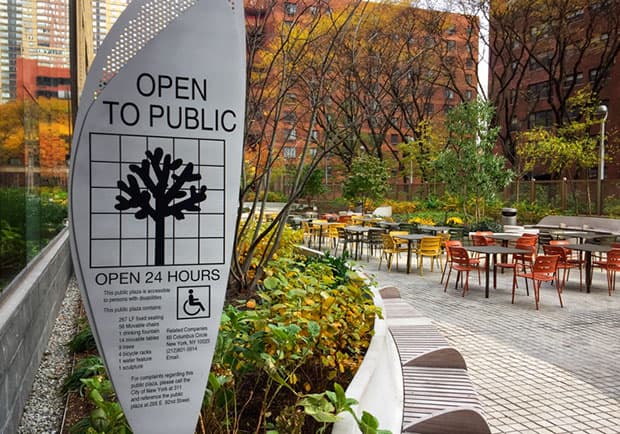
Air rights are uniquely New York (say that five times fast), but another particularly strange idea is the Privately Owned Public Space, or POPS. The concept is exactly what it sounds like: a space that is privately owned but legally available for the public to use. This can be a plaza, a garden, an arcade, a passageway, or even an indoor space. The property owner owns it, but the city requires that it be available to everyone.
New York always wants more public space. In the industrial boom of the 1800s, the city looked to Hyde Park in London and Tivoli Gardens in Copenhagen and realized the city needed to breathe a little, leading to the creation of Central Park. A century later, the same revelation occurred, but the city didn’t have the space to build another park bigger than Monaco. Since developers wanted taller buildings, the city cooked up this deal: the more public space you give to the city, the more we’ll thank you by letting you build higher.
Over the years, this has created hundreds of POPS throughout the city. Some are enormous and obvious. Others are tiny spaces tucked between buildings that you could walk past every day without realizing they were technically public. Some POPS that take the form of passageways through buildings, allowing pedestrians to cut through blocks instead of walking around them. And when you put enough of those passageways together, you get something particularly New York: an avenue that isn't really an avenue. That's where 6½ Avenue comes in. It's a street that isn't quite a street, made possible by spaces that aren't quite public, created through rules that are designed to make private development give something back to the city.
There’s an easy way to find a POPS, and a bizarre story behind it. The old logo featured a stylized tree sitting above a kind of grid, but if you didn't already know what POPS were, though, it wasn't necessarily going to tell you much. So in 2019, The Department of City Planning, the Municipal Art Society, and Advocates for Privately Owned Public Space held an international design competition, asking designers to come up with a new symbol for the city's POPS. 607 designs were submitted from nearly 60 countries. The submissions were put on public display, and New Yorkers were invited to vote for their favorites. Around 17,000 people voted.
Three designs were ultimately selected as awardees. One was called “More Than a Tree,” pettily submitted by Gensler's New York Brand Design Studio. Another was “Constellation,” by designer John Schettino. And the third, the winner, was “Have a Seat,” by New York graphic designer Emma Reed. It's remarkably simple: three chairs. It’s, well, it’s just three chairs. The idea was that the chairs communicate something much more useful than a tree ever could: you are welcome here. Have a seat.
The zoning rules can seem impossibly strict. And they are. But the rules also contain exceptions, trades, transfers, special districts, bonuses, and decades' worth of decisions about what the city is willing to allow. And that's what makes New York so much fun. The city's strangest places aren't necessarily accidents or violations. They're often the physical evidence of someone finding a creative way to work within an incredibly complicated set of rules.
Our tours take place on 6½ Avenue because it's a perfect example of that idea. On the surface, you're simply walking through Midtown. But look a little closer and you're walking through a strange collection of zoning agreements, privately owned public spaces, and urban design decisions that have quietly reshaped the city.
Come check out a tour to see one of the most bizarre POPS in the city, and while you’re in Midtown, here are some more POPS worth checking out!
- Paley Park - 3 E 53rd Street. It’s just 4,200 square feet (which may seem small, but in NYC, that’s a mansion) and centers a 20-foot-tall waterfall that masks the sounds of Midtown. It’s the perfect place to drink a morning coffee and briefly pretend you aren't in Midtown.
- Ford Foundation Atrium - 320 E 43rd Street. Walk through what looks like an imposing office building and suddenly find yourself in a 12-story indoor jungle. The glass-walled atrium is filled with nearly 40 species of plants, winding paths, and a reflecting pool. Find someone who works there and they will happily give you a free tour.
- Worldwide Plaza - 825 8th Avenue. The sprawling complex contains a landscaped public plaza with seating and water features, offering a surprisingly pleasant place to sit, eat, or decompress just a few blocks from Times Square. It is also formally MSG III, where Marilyn Monroe sang happy birthday to JFK!
- 550 Madison Avenue. In 2022, this former indoor passageway was transformed into a lush public garden. There are trees, shrubs, fountains, seating, food kiosks, and a giant glass canopy overhead; an urban conservatory dropped into the middle of Midtown.