
What is 6 1/2 Avenue?
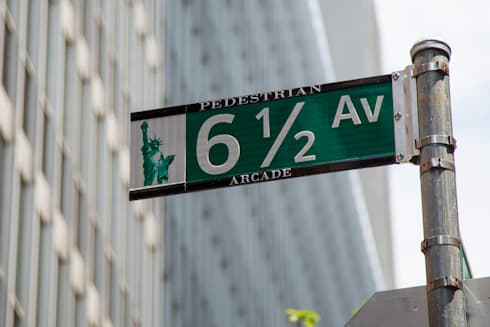
When I first learned that New York City has a 6 ½ Avenue, I was sure it was a joke. New York City has some of the most thoughtful urban design in the world, how is that there is such a fluke as a half avenue?
In 1807, Gouverneur Morris, John Rutherford, and Simeon de Witt were given until 1811 to come up with a street plan for New York City. They didn’t have to have any specific number of meetings or even take notes, they were simply given unbridled power to make what would become one of the most important decisions in New York City history. Furthermore, none of them were necessarily qualified! Morris was a B-list founding father, whose greatest achievement was writing the Preamble to the Constitution (so he is the people). Rutherford was, at the time, New York’s largest land owner. De Witt is the only one who fit the more traditional bill; he was a surveyor who made maps for George Washington during the Revolutionary War. A writer, a rich man, and one cartographer were given the keys to building the city.
Before this, the city was being built more or less randomly, with landowners building their own access roads on their property. Everything below Houston Street (pronounced “how” not “hue,” due to it being a Georgian name. You can spot a tourist a mile away based on how they pronounce that word) is the “chaos” part of the city. Everything about Houston began the three men’s project.
They had four years. They weren’t procrastinators, they were protriennators (which is a hilarious joke if you studied Ancient Latin for six years and had little social life in high school… like me). Even though they were hired in 1807, they didn’t start until the end of 1810, giving them less than a year. Unfortunately, because they didn’t have to keep minutes in any meeting, we can only guess what that last year was like.
But the plan they released was relatively simple. In short: avenues would run the length of the island, starting with 1st Avenue on the Eastern side, and ending with 12th on the Western side. Streets would run perpendicular, beginning at 1st Street (right above Houston), and going to 155th, today around the Southern border of Washington Heights. There are many exceptions to this grid, but the idea stuck, and the progress to build it began almost immediately.
The biggest exception to this grid came with Broadway, the oldest street in New York City, and the only one to stretch the entire length of the island. It can be traced back to a Lenape trade route thousands of years ago, and for that reason, became a massive diagonal line cutting through Manhattan. Just like they kept Lower Manhattan in its original confusing state, they kept Broadway as a glacial crack in the middle of the island.
Knowing all of this, it is safe to assume that 6 ½ Avenue is another one of these strange cracks, yes? No! 6 ½ Avenue has a totally different story, and was sort of created by accident. I’m aware the idea of urban infrastructure being created accidentally seems absurd, but if it can happen for the Central Park Zoo (a story for another day), it can happen here.
6 ½ Avenue, by definition, is a series of pedestrian passageways that stretch the length of 51st Street to 57th Street (about a quarter of a mile, 400m), literally between 6th And 7th Avenues. To be clear, these passageways are not open to any vehicles, the traffic is strictly that of the workerbee New Yorker. Each of these individual passageways began popping up separately as early as the 1970s as indoor and outdoor plazas, officially titled Privately Owned Public Space (or POPS). Some of them are lobbies, some are restaurant terraces, some feel like hidden oases.
By the time we reach the 90s, thousands of people would be using these plazas as walkthroughs. It was purely coincidental, but they lined up in a way that they almost formed a street, you just needed a little bit of jaywalking to get from plaza to plaza. Locals held this secret as a way to get from 51st Street all the way to 57th while avoiding Times Square to the West and Rockefeller Center to the East. In 2011, the Friends of POPS proposed to make this hidden and rather dangerous series of walkways safer and official. The original proposal called this walkway Holly Whyte Way, named after the urbanist and writer whose research on how people use public spaces helped shape New York City’s POPS program. However, someone probably said something like “we should call it 6 ½ Avenue, because it is halfway between 6th and 7th Avenue.” The plan was simply to add crosswalks between each POPS, and put up some whimsical, Harry Potter looking street signs. In March 2012, the proposal was unanimously voted for and approved, and the $60,000 project was completed that July.
In the past decade and a half, this hidden crack in the grid has found new pedestrian life, and has revealed an exciting new layer of city living. It is for this reason that we found 6 ½ Avenue to be the perfect location for GLO’s flagship tour. We are, similarly, revealing a new layer of the city through Augmented Reality. We’re able to see things that are both there and not there at the same time. It’s a little trippy, and it’s also analogous to the reality of this part of Midtown; it is both a street and not a street. Sometimes the best part of exploring the city is discovering these hidden secrets.
If you want to explore 6 ½ Avenue and shine light to the city in ways you’ve never been able to do before, come join us on a GLO tour!