
Why We Crave Immersive Experiences Now More Than Ever
Have you noticed how much of a buzzword “immersive” has become lately? Everything is immersive. Experiences are immersive. Attractions are immersive. Exhibitions are immersive. Restaurants are immersive. IKEA is immersive. Ice cream is immersive. Rooms filled with lights, projections, mirrors, soundscapes, and oversized installations have all been labeled immersive, and now the word itself is starting to lose some of its meaning. Like an invasive species, "immersive" has spread everywhere, attaching itself to nearly every new experience that promises to be bigger, more memorable, or more Instagram-worthy than whatever came before it.
Before you say anything, I recognize the irony here: I am quite literally the Manager of Immersive Experiences at GLO, so I am fully aware that this article is putting me dangerously close to "barber complaining about his receding hairline" territory. But maybe that is exactly why we should be asking a different question: why has this word become so popular in the first place? Yes, the word is overused, but the desire behind it is very real. The best immersive experiences aren't defined by the size of their screens, the complexity of their technology, or how many photos they generate. They are defined by something much more human: connection, participation, and empathy. So why, at this particular moment in history, are people craving these types of experiences more than ever?
Part of the problem is that we've begun to confuse immersion with spectacle. Somewhere along the way, "immersive" became shorthand for oversized projections, dramatic lighting, and a carefully curated backdrop for social media. There is nothing inherently wrong with beautiful spaces; they can inspire wonder, curiosity, and awe. But surrounding someone with something is not the same as involving them in it. A room can be visually stunning and still leave you emotionally untouched. A truly immersive experience doesn't just change what you see; it changes how you relate to the people and the world around you.
The reality is that there would not be such an "immersive" boom without a reason. Humans have always been drawn to unique experiences, whether as spectators or participants. We gathered in Ancient Athens for the Dionysia, filled Roman arenas, cheered at medieval jousting tournaments, and continued to tune in to the Olympics, concerts, films, and live performances because there is something deeply human about witnessing greatness unfold before us. But we have also danced in festivals, marched in parades, celebrated through communal rituals, and told stories together around campfires. It wasn't until the rise of mass media (radio, film, television, and eventually streaming) that observation became our dominant way of engaging with stories.
But something has shifted. Increasingly, audiences are no longer satisfied with staying on the sidelines. We don’t just want to watch the adventure; we want to be part of it. We don’t just want to see something magical happen; we want to feel like it happened to us. Perhaps that is why more and more people are crazy enough to want to run with the bulls instead of simply watching other people do it. The rise of immersive experiences is a progression, not rejection, of traditional entertainment. After centuries of watching others have incredible experiences, we are increasingly craving the chance to create our own.
Walking through Central Park recently, I watched a street performer do a backflip and had one of those strange flashes of imagination where, for just a moment, I felt like I could do it too, even though I know I absolutely cannot (correction: I can do a backflip exactly once). The feeling was ridiculous, but also strangely real, and there was something almost sad about realizing that this incredible experience would probably never be mine. For centuries, we have found wonder in watching people do things we never could, from athletes breaking records to performers defying expectations and artists creating things beyond our abilities. But perhaps the next evolution of entertainment is finding ways to close that gap. Through technology and art, we are beginning to create experiences that let us briefly step into worlds and roles we might never otherwise enter, not just watching someone else have an unbelievable moment, but feeling what it might be like to have one ourselves.
Perhaps this desire has felt extra strong in the current age because, despite us having more connectivity than any other point in human history, loneliness and separation are at an all time high. President Obama said we are in an empathy deficit. Former U.S. Surgeon General Dr. Vivek H. Murthy said that one in every two Americans consider themselves lonely. People are increasingly needing presence and authentic human connection. People want to laugh together, to cry together, to explore our world together, to think with people who think differently than us, to love more than we like. I can’t entirely blame social media, because it has allowed us to discover things we never thought we could and maintain relationships throughout impossible distances. Also, ironically, social media has blurred the line between audience and performer. It transformed billions of people from viewers into creators, giving everyone a stage and inviting everyone to perform.`
But there is a fundamental difference between participation and connection. Social media keeps us trapped as observers and participants at the same time. We are simultaneously watching other people live their lives and curating our own lives for others to watch. Instead of escaping the role of observer, we have become observers of ourselves, constantly aware of how a moment appears from the outside rather than simply experiencing it from within. We’re still missing that presence and that genuine connection.
Of course, one of the biggest factors in this renewed desire for connection came from the COVID-19 pandemic. We spent months isolated from the world around us, and we immediately began inventing new ways to bridge that distance. Virtual lectures, workshops, performances, and even tours became ways to maintain some sense of shared experience when gathering together physically was impossible. You may remember the ritual that began in New York City on March 27, 2020 (just one week after the state-mandated lockdown) when people began opening their windows at 7pm every evening to clap, cheer, and bang pots and pans in honor of essential workers. On paper, it was a very simple and unobtrusive gesture. But emotionally, it was something much stronger: a reminder that even when we were physically separated, we were still part of something together.
Like a plant deprived of sunlight, once restrictions finally lifted, people rushed toward opportunities to gather again safely and enjoyably. Restaurant reservations were booked instantly. Musicians did concerts in drive-in theaters. Live experiences became more valuable because we had spent so long without them.
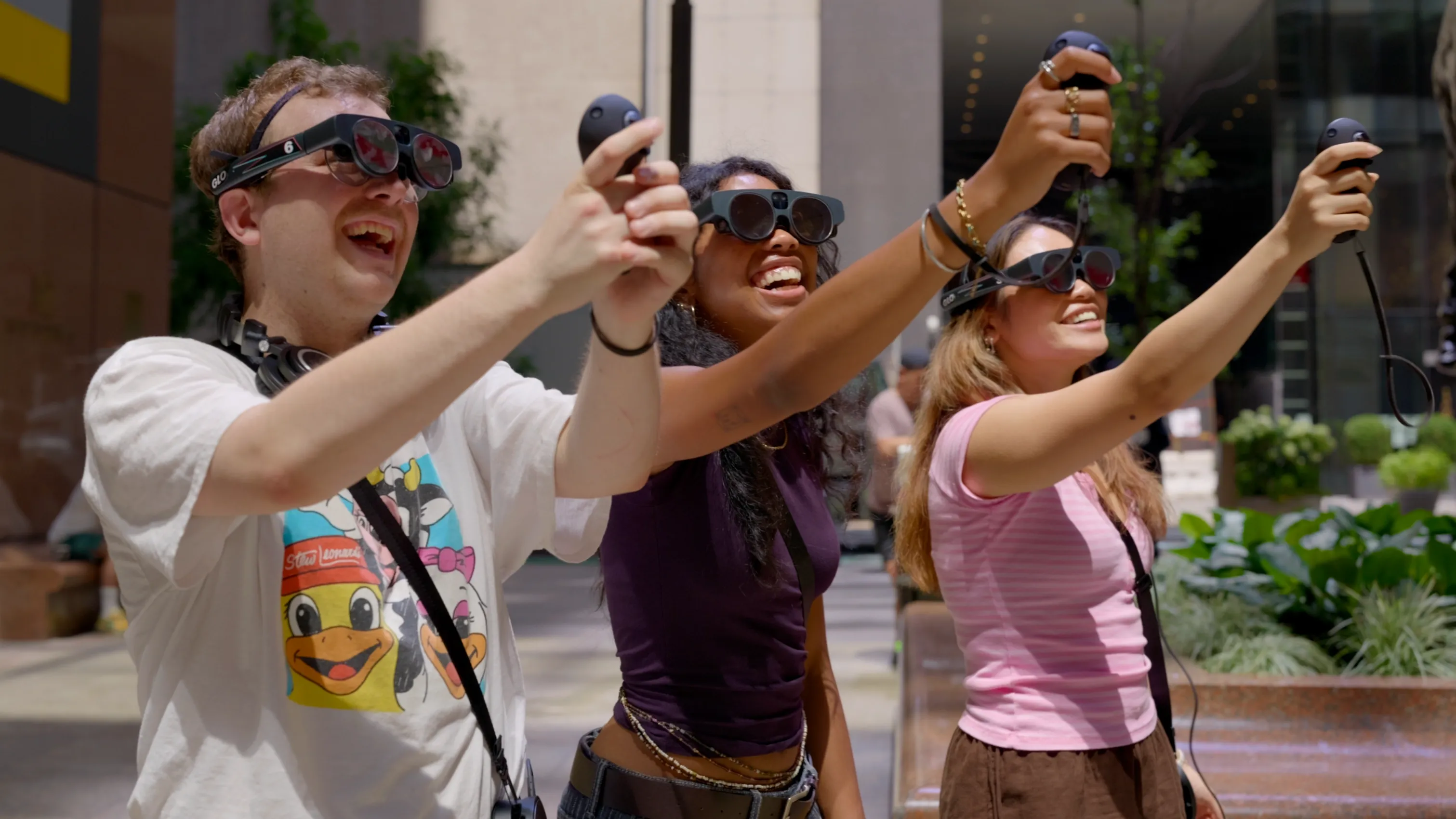
Nowadays, immersive entertainment tends to lean heavily into high-tech indoor installations to escape reality. At GLO, we take a different approach by using Augmented Reality headsets, one that might seem counterintuitive at first. Putting on a headset sounds like the opposite of becoming more present. But unlike disappearing into Virtual Reality, the technology is designed to pull your attention back to the streets around you, and, more importantly, to the people walking beside you. The headset is a magical addition that can be experienced communally.
The streets of Midtown Manhattan are already lush with stories, hidden histories, and unexpected details. GLO adds another layer, one where guests can interact, play, compete, create, and discover together. We have used the technology as a catalyst for connection. It is the laughter after winning a massive boss battle, the teamwork that forms between friends (or strangers) in painting a new piece of art, the joy of making a shared discovery, and the memories that only exist because you experienced them together. We’re able to immerse people not just in a new world, but in each other.
So perhaps the reason "immersive" has become such a buzzword isn't just because the entertainment industry has run out of adjectives. Perhaps it's because the word captures something we've been begging for. In an era where we are more connected than ever, we are also searching for experiences that make us feel present. We are looking for opportunities to stop watching, stop performing, and start participating. To laugh with strangers who become teammates. To discover something unexpected alongside the people we care about. To leave not just with a photo on our phones, but with a story we'll tell for years. Maybe the future of immersive entertainment isn't about escaping reality at all. Maybe it's about helping us reconnect with it and with each other.
Join a GLO tour today by clicking here. I can guarantee two things: 1) you will make a friend, 2) I will not do a backflip.